
The immense size of the foreign exchange market has always captured my fascination. The foreign exchange market holds the title of the largest financial market in the world because its daily trading volume exceeds an impressive $9.6 Trillion in 2025.
The large forex market provides traders with exceptional opportunities to earn profits through worldwide currency trading. If you’re wondering “Why trade forex?”, you’re in the right place. We need to look at the primary advantages of forex trading to understand why millions of traders choose it across the globe. So keep reading.
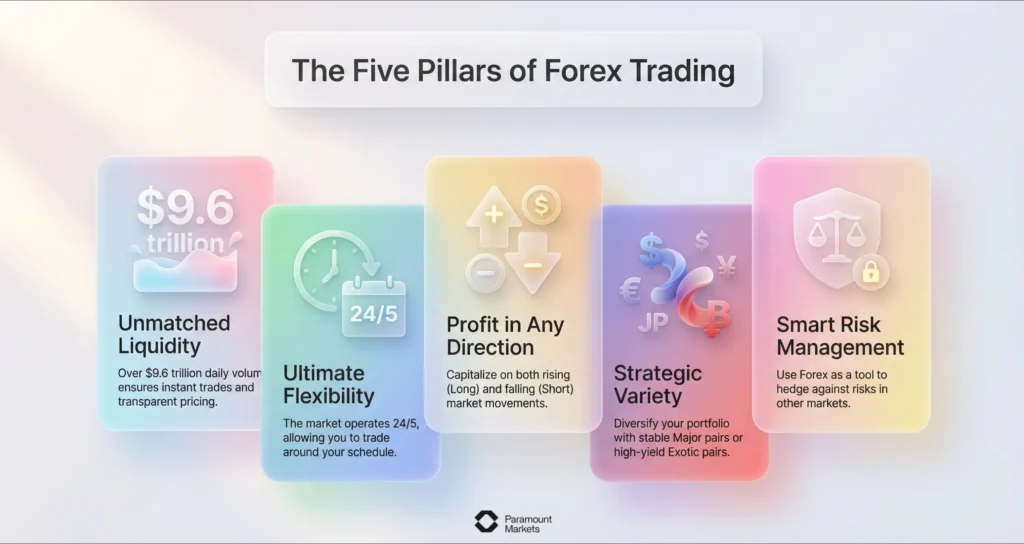
Why Trade Forex? Benefits of Forex Trading
I find forex trading captivating because it provides more access and liquidity and greater flexibility than other financial markets. The forex market provides numerous benefits which make it appealing for traders at every stage of their financial journey.
Let’s examine some of the most persuasive motivations for choosing forex trading over other financial instruments.
24/5 Market Hours: Trade Around the Clock
The forex market operates round-the-clock for five days each week which stands out as its most attractive feature to me. The forex market operates continuously because of its OTC structure while major financial centers like New York, London, Tokyo and Dubai contribute to its global reach.
This continuous trading schedule offers fantastic flexibility. Both full-time traders and busy individuals with trading goals have the ability to select market participation times which fit their personal routines.
Forex stands out because its market operates continuously which enables traders to seize opportunities anytime outside regular business hours. Taking advantage of 24/7 market access stands as one of multiple strong reasons to trade forex. There’s so much more to discover.

High Liquidity: Easy to Enter and Exit Trades
The outstanding liquidity of forex trading is one of its most appealing features for me. How does the market’s liquidity impact both you and me?
Essentially this means that there exists an abundance of both buyers and sellers who are prepared to engage in trading activities. This market sees billions of dollars flowing through its system every single minute. The enormous trading volume enables traders to carry out their transactions promptly while achieving high levels of price clarity.
Large liquidity levels provide a major benefit by reducing price manipulation risks which are more common in small markets where dominant participants can sway prices.
Major currency pairs such as EUR/USD and USD/JPY as well as exotic pairs like USD/AED and USD/SAR allow traders to enter and exit their positions without significant price fluctuations or slippage. The entire trading procedure becomes much more streamlined thanks to this feature.
Wide Range of Currency Pairs
The forex market’s vast array of currency pairs for trading stands out to me as an exhilarating aspect. The forex market provides traders with worldwide economic opportunities that are readily accessible.
Major currency pairs represent dominant trading options, while minor and exotic currency pairs offer unique opportunities despite their rarity. Traders receive broad strategic options from the market’s extensive selection which allows them to exploit various global economic conditions.
- EUR/USD (Euro/US Dollar), GBP/USD (British Pound/US Dollar), and USD/JPY (US Dollar/Japanese Yen) stand as the most frequently traded major currency pairs.
- Expanding your trading scope involves looking into minor currency pairs such as EUR/GBP (Euro versus British Pound), AUD/JPY (Australian Dollar versus Japanese Yen), and GBP/JPY (British Pound versus Japanese Yen).
- Investors seeking high-yield trading possibilities should consider exotic currency pairs such as USD/TRY (US Dollar/Turkish Lira), EUR/ZAR (Euro/South African Rand), and USD/SGD (US Dollar/Singapore Dollar).
The large variety of trading pairs provides traders with the ability to analyze economic conditions across different regions while finding profitable trading opportunities in diverse economic scenarios. The forex market accommodates every trader through its high liquidity major pairs and distinctive exotic pair options.

Go Long or Short: Profit in Any Market Condition
If you still ask why trade forex, I say one of the major advantage of forex trading is that it provides traders the opportunity to earn profits whether market conditions are rising or falling.
Each forex transaction requires buying one currency while selling another which enables traders to adopt a long position if they believe a currency will gain value and a short position if they forecast its decline.
Dual-directional trading allows traders to find profit opportunities in all market conditions because they can operate in both rising and falling markets. The ability to trade in both directions makes forex more attractive than stocks that generally move in one direction.
Volatility: Opportunities for Profit
Numerous trading opportunities arise because of the forex market’s well known volatility. Economic indicators such as GDP, inflation rates and interest rates cause price fluctuations that traders use to benefit from short term market movements.
Financial events and decisions from major central banks including the Federal Reserve and Central Bank of UAE can produce major market fluctuations which enable traders to earn profits through precise timing of their trades.

Low Transaction Costs and No Fixed Lot Size
The expense of trading forex remains cheaper when compared to other financial markets. Forex brokers such as ParamountMarkets, XM, IG and Exness provide accounts with narrow spreads that operate without commission charges. In forex trading traders have the ability to select trade sizes according to their available capital and risk acceptance levels because there is no mandated fixed lot size.
The trading market provides three primary categories for lot sizes which traders must know.
- Standard Lot: The largest lot size consists of 100,000 units of the base currency.
- Micro Lot: Represents 1,000 units of the base currency.
- Mini Lot: The Mini Lot equivalent amounts to 10,000 units of the base currency.
Traders benefit from this flexibility because it allows them to control risk while optimizing their potential profits.
Leverage: Amplify Your Trading Potential
Traders can manage larger positions than their capital would normally allow through the use of leverage. The access to leverage options stands out as a reason why forex trading is more appealing compared to other financial markets. For example, 1:100 leverage ratio allows you to trade $100,000 with only $1,000 of your capital, but amplifies losses in the same proportion.
Depending on the broker and regulatory bodies such as DFSA, SCA, ADGM, SAMA, and CBE, you can access leverage ratios of 1:30, 1:50, 1:100, or even 1:500. ParamountMarkets stands as an offshore broker that provides traders with a maximum leverage ratio of 1:1000.
Note: While leverage can boost profits it also brings higher risk which works like a double-edged sword.

Hedge Against Risk
Businesses and investors employ hedging in forex as a protective measure to avoid losses triggered by market fluctuations. A business can enter forex market positions to counteract potential losses when it foresees a drop in the foreign currency value. Forex trading provides portfolio balance and diversification when investors face different market risks including stock market downturns.
Forex hedging involves opening several strategic positions to lessen market volatility’s effects. A typical hedging technique involves trading two related currency pairs such as GBP/USD alongside EUR/USD.
A trader that suffers financial losses with the EUR/USD currency pair can gain profits from GBP/USD which lowers their total risk exposure. While hedging can mitigate some risks, the changing nature of correlations means that market exposure remains a possibility.
Important Considerations for Trading Forex
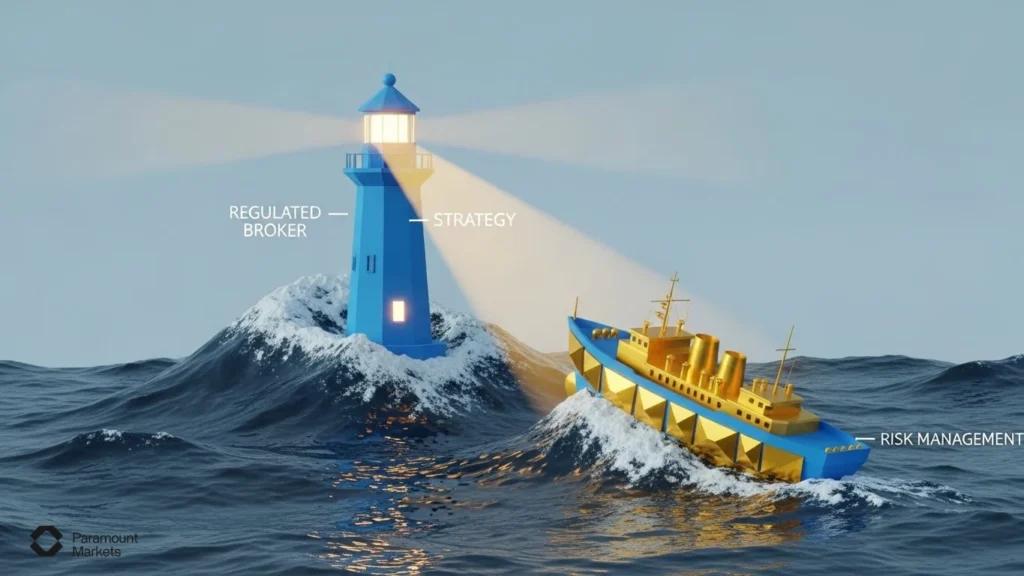
There are a lot of forex trading opportunities, but it also comes with challenges. Before starting forex trading you must consider market volatility along with essential risk management tools like stop-loss and take-profit orders and the importance of maintaining a disciplined trading strategy.
After understanding why trade forex you need to evaluate these top considerations.
The forex market faces swift price movements because of economic indicators such as GDP figures together with inflation rates and interest rate changes. Volatility in the forex market creates potential profits and at the same time elevates the risks.
Leverage offers traders the ability to control large positions with minimal capital but can result in substantial losses when misused.
Having a well-defined trading strategy is essential in forex trading for beginners and professionals.
Selecting a broker regulated by authorities provides secure trading conditions. ParamountMarkets provides traders with both a safe trading platform and competitive spreads.
The use of stop-loss and take-profit orders together with correct position sizing serves as protection for your trading capital through effective risk management.
Long-term forex trading success depends on emotional control and patience while avoiding quick and impulsive decisions.
Why Forex Is a Better Choice Than Stocks for Some Traders
When comparing forex vs stocks trading, forex trading offers several benefits over stock trading through greater flexibility and liquidity along with worldwide market access.
The forex market operates 24 hours a day from Monday through Friday while the stock market only trades during specific hours requiring a more systematic approach.
Here’s a comparison between the two:
| Feature | Forex Trading | Stock Trading |
|---|---|---|
| Trading Hours | 24/5 (New York, London, Tokyo, Dubai sessions) | Limited to business hours |
| Liquidity | High liquidity, especially in major currency pairs | Lower liquidity outside peak hours |
| Leverage | Higher leverage (up to 1:500 with brokers like ParamountMarkets) | Limited leverage (typically 1:2) |
| Volatility | Frequent price movements create opportunities for traders | Generally lower volatility, especially in blue-chip stocks |
| Influencing Factors | Impacted by central banks like the Federal Reserve and ECB | Driven by company earnings and industry performance |
| Transaction Costs | Low spreads and commission-free options available | Higher transaction fees and brokerage commissions |
Note: Forex trading provides traders with flexible options and fast trading execution for global currency market access. Long-term investors who prioritize stability and income from dividends should choose stocks as their investment vehicle.
Maximize Your Forex Trading Potential with ParamountMarkets
The partnership with a reputable forex broker stands as an essential step for anyone who wants to benefit from the forex market.
ParamountMarkets distinguishes itself with competitive spreads alongside an intuitive MetaTrader 5 platform and access to numerous major currency pairs.
ParamountMarkets provides an outstanding customer service experience and advanced risk management features like trailing stop-loss which together with its smooth trading platform enable traders of all skill levels to reach their maximum forex trading potential. The platform features educational blogs that explain how to start forex trading.
Conclusion
Once all advantages of this financial market are considered, the answer to why trade forex is clear. The forex market surpasses traditional stock markets by providing superior flexibility together with higher liquidity and better accessibility. Effective risk management practices combined with a defined trading strategy and selecting an appropriate broker are essential for successful forex trading.
ParamountMarkets delivers a secure trading environment and powerful platforms along with essential tools to help you confidently operate in the forex market. Join our platform today to trade with a reliable broker who supports your trading success.
FAQ
How does forex trading flexibility compare to the stock market?
Unlike traditional stock exchanges that operate during fixed business hours, the forex market functions as a global Over-the-Counter (OTC) market. This allows trading to continue 24 hours a day, five days a week across different time zones. For traders, this means the ability to react to news and manage positions globally without being restricted to a single exchange’s opening and closing bell.
What does it mean to take a "short position" in forex?
In forex, trading is always done in pairs. Taking a “short position” simply means you are selling the base currency in anticipation that its value will drop relative to the quote currency. This mechanism allows traders to potentially benefit from market downturns just as they would from rising markets, provided their market analysis is correct.
Is a large amount of capital required to start trading?
Not necessarily. The barrier to entry in forex is generally lower than in other financial markets due to the availability of “Micro” and “Mini” lots. These smaller contract sizes allow individuals to participate in the market with modest capital. However, traders should always ensure they have sufficient capital to manage risk effectively, regardless of the entry amount.
What are the realistic risks associated with high leverage?
While leverage allows traders to control larger positions with a smaller deposit, it is often described as a “double-edged sword.” It amplifies gains, but it equally amplifies losses. If the market moves against a highly leveraged position, it can lead to rapid depletion of trading capital. Therefore, professional traders consider leverage a tool that requires strict risk management, not just a way to boost profits.
How can forex be used to hedge against economic risks?
Hedging is a risk management strategy used to offset potential losses in other investments. For example, if an investor holds international stocks, they might trade forex to protect against currency fluctuations that could devalue those stock holdings. By taking an opposing position in a related currency pair, traders aim to neutralize the risk exposure caused by market volatility.
Disclaimer: The information provided in this article is for educational and informational purposes only and does not constitute financial advice, investment recommendations, or an offer to buy or sell any financial instruments. Trading Foreign Exchange (Forex) and Contracts for Difference (CFDs) involves a high level of risk and may not be suitable for all investors. Leverage can work against you as well as for you. Before deciding to trade, you should carefully consider your investment objectives, level of experience, and risk appetite. You should not invest money that you cannot afford to lose.
